
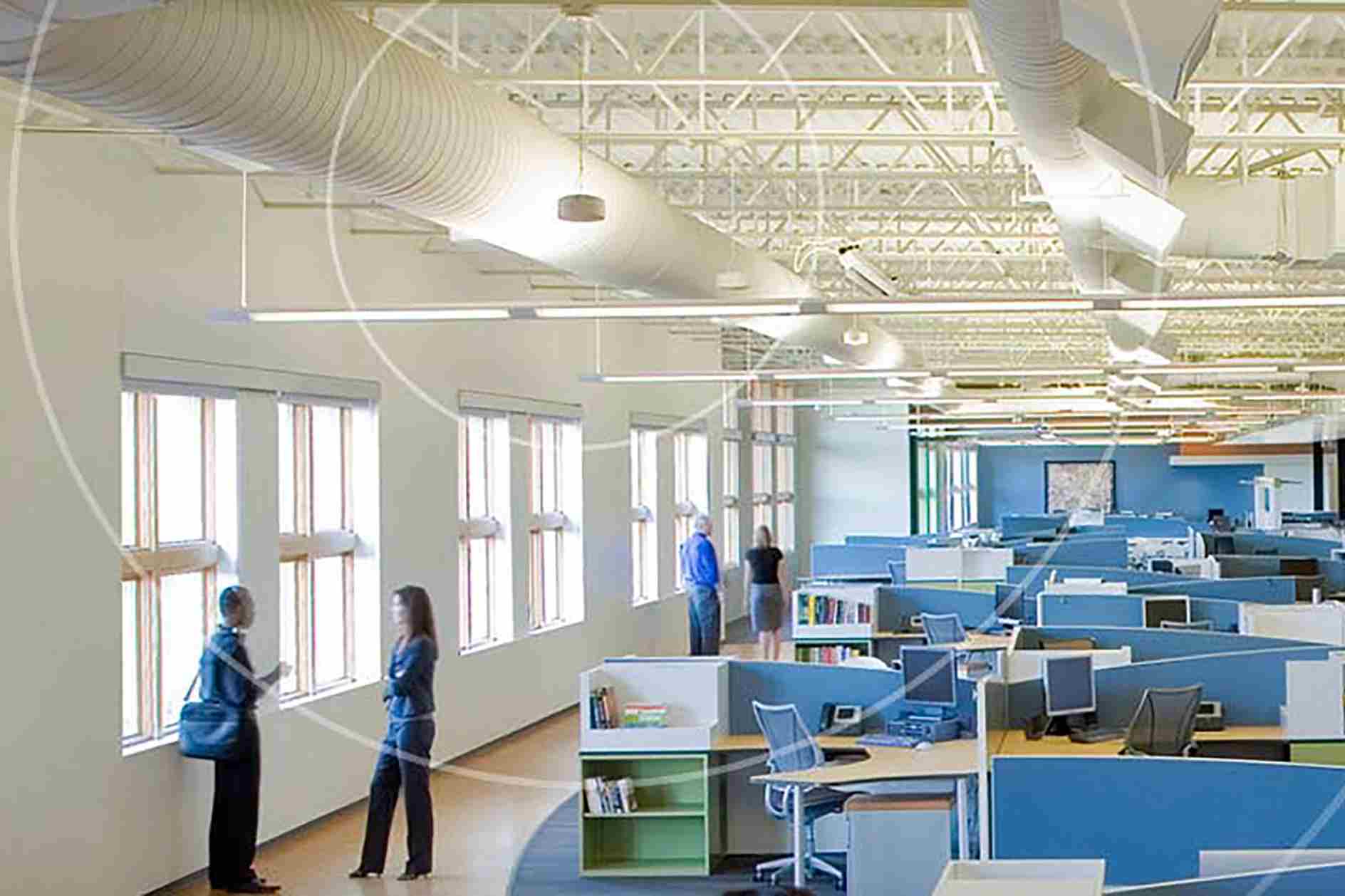
If you have ever tried to concentrate in an open-plan office while a colleague talks loudly two desks away, you already understand the problem that a sound masking system is designed to solve. By introducing a carefully engineered layer of background sound, masking technology makes speech less intelligible to unintended listeners, reducing distraction, improving focus, and protecting the privacy of sensitive conversations.
It is one of the most effective and cost-efficient acoustic interventions available for modern workplaces and commercial spaces.
What Is a Sound Masking System?
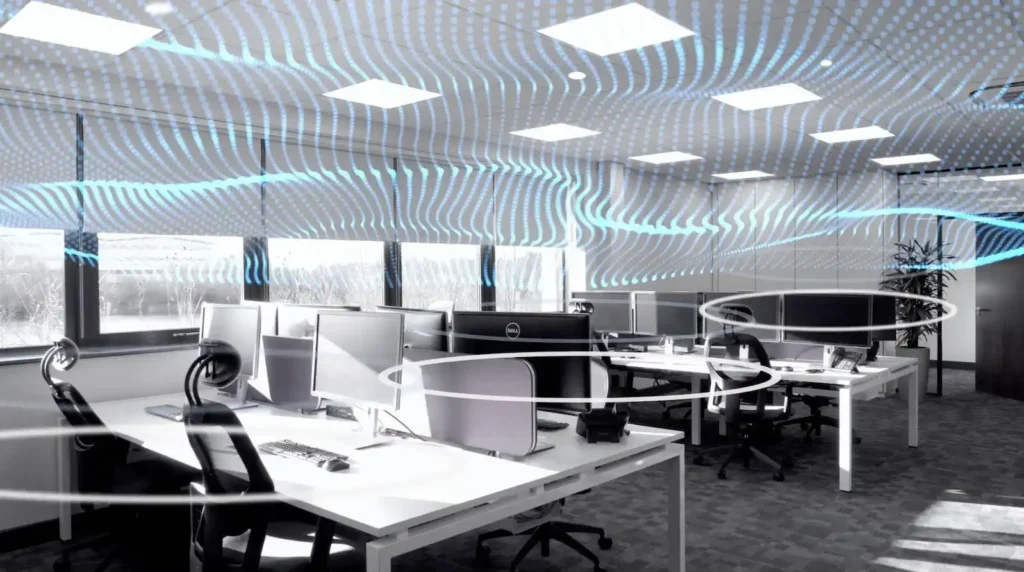
A sound masking system introduces a continuous, specially shaped background sound into a space. This sound is engineered to match the frequency profile of human speech, making it harder for people to involuntarily process conversations happening nearby. It does not block or cancel sound — it makes speech blend into the acoustic background, reducing its intelligibility and therefore its distraction potential.
The masking sound itself is often described as similar to gentle airflow or a soft white noise. At the correct level, it is barely perceptible to the people working in the space — present enough to do its job, but not so loud as to become a distraction in its own right.
The result is what acoustic engineers call a higher speech privacy index. Conversations are still happening, but the people around them are less likely to understand what is being said — and far less likely to be distracted by it.
Why Open-Plan Offices Need Sound Masking
The open-plan office is now the dominant workplace design, and it brings well-documented acoustic challenges. Without walls or partitions to block sound, conversations travel freely across the floor. A single phone call, meeting, or casual conversation can disturb dozens of people in a large open-plan space.
The problem is not just distraction — though that is significant enough. Research consistently shows that speech is the most disruptive form of background noise for cognitive work. Intelligible speech — conversations you can follow involuntarily — pulls cognitive resources away from the task at hand, reducing accuracy and increasing time-on-task for complex work.
Sound masking reduces this effect by making overheard conversations less intelligible, without requiring people to wear noise-cancelling headphones or sit in isolated booths.
Applications Beyond the Open-Plan Office
While the open-plan office is the most common application, sound masking is valuable in a wide range of environments:
Healthcare and Medical Facilities
Patient privacy is both an ethical obligation and a regulatory requirement in healthcare settings. Consultation rooms, reception desks, and waiting areas can all benefit from sound masking, ensuring that conversations between patients and clinicians remain confidential even in busy environments with thin walls.
Legal and Financial Services
Law firms, accountancy practices, financial advisors, and HR departments regularly handle sensitive discussions. Sound masking provides an added layer of acoustic privacy in consultation rooms and adjacent spaces, reducing the risk of confidential information being overheard.
Call Centres
In call centre environments, the background noise of many simultaneous conversations can be distracting for staff and audible to customers on calls. Sound masking helps to reduce the acoustic impact of this environment, improving both staff concentration and call quality perception.
Libraries and Study Spaces
Modern libraries balance quiet study areas with collaborative spaces. Sound masking can help define acoustic zones, reducing the impact of conversation areas on adjacent quiet zones without the need for physical partitioning.
Conference and Meeting Rooms
Sound from meetings can leak into adjacent corridors or rooms, particularly in buildings with lightweight partition walls. Masking in corridors and adjacent spaces reduces the intelligibility of this sound, providing greater speech privacy for in-room discussions.
How a Sound Masking System Is Installed
A properly engineered sound masking system uses a network of small loudspeakers, typically installed in or above the ceiling, to distribute the masking sound evenly across the space. Key elements of the installation include:
Speaker Placement — Speakers are positioned to deliver even masking coverage across the zone. Gaps or hotspots in coverage reduce effectiveness. System design ensures even distribution.
Frequency Shaping — The masking signal is not simply white or pink noise — it is carefully shaped to match the frequency profile of speech, maximising its effectiveness at the lowest possible level.
Level Setting and Calibration — The masking level must be set correctly. Too low and it has little effect; too high and it becomes a distraction itself. Proper commissioning involves acoustic measurement and careful level calibration zone by zone.
Zone Control — In large spaces, masking levels may need to vary between zones — higher in noisy areas, lower in quieter spaces. Zone control allows this flexibility.
Integration with Other Systems — Sound masking can be integrated with background music and PA systems, sharing infrastructure or running as a dedicated overlay.
What to Expect from a Sound Masking Installation
A well-designed and properly commissioned sound masking system delivers immediate and noticeable improvements to the acoustic environment, especially when integrated with a professional Public Address system for better communication and sound management:
- Reduction in the distraction caused by overheard conversations
- Improved concentration and productivity for office workers
- Greater speech privacy in consultation and meeting areas
- A calmer, more comfortable working environment overall
- Reduced complaints about noise from staff and visitors
The effects are not dramatic — masking works subtly, as it should. But the difference between a space with and without a properly calibrated masking system is consistently noticed and appreciated by the people working in it.
Contact Us
Sound Directions designs and installs sound masking systems for workplaces, healthcare facilities, and commercial environments across the UK. If your space has an acoustic privacy or distraction problem, we would be glad to help. Contact us today to discuss your requirements and find out what sound masking could do for your environment.
Frequently Asked Questions
Will the masking sound be noticeable to people in the office? A correctly calibrated system should be barely perceptible. Most people become aware of it only when it is pointed out or when it is switched off. If the masking sound is clearly audible and noticeable, it is either too loud or incorrectly shaped.
Does sound masking block all conversation noise? No. Sound masking reduces the intelligibility of speech, not its volume. People may still be aware that a conversation is happening nearby, but they will be less able to follow its content and less distracted by it.
Can sound masking be combined with background music? Yes. Many installations combine sound masking with background music, either using shared speaker infrastructure or separate systems. The two serve different purposes and work well alongside each other.
Is sound masking suitable for open-plan offices with acoustic ceiling tiles? It works well in such environments. Acoustic ceiling tiles reduce reverberation, which can slightly reduce the throw distance of masking speakers — but this is accounted for in the system design.
How long does a sound masking installation take? For a standard open-plan office installation, deployment is typically completed within a day or two, depending on size. Commissioning and calibration may add additional time.
Does sound masking help with compliance with GDPR or data protection requirements? Sound masking can form part of a broader approach to protecting the privacy of verbal communications in a workplace — which is relevant to GDPR obligations around data handling. However, it is one element of a wider physical and procedural privacy framework, not a standalone compliance solution.